
KMOB1003 Global Protection Partner

KMOB1003 Intelligence | Leadership & Culture
What Classrooms Are Discovering About AI and Thinking — And Why Every Business Leader Should Be Paying Attention
Written work is coming back flawless. Explanations are empty. AI made the gap visible. The question now is who closes it — and whether business is ready to carry its share of the load.
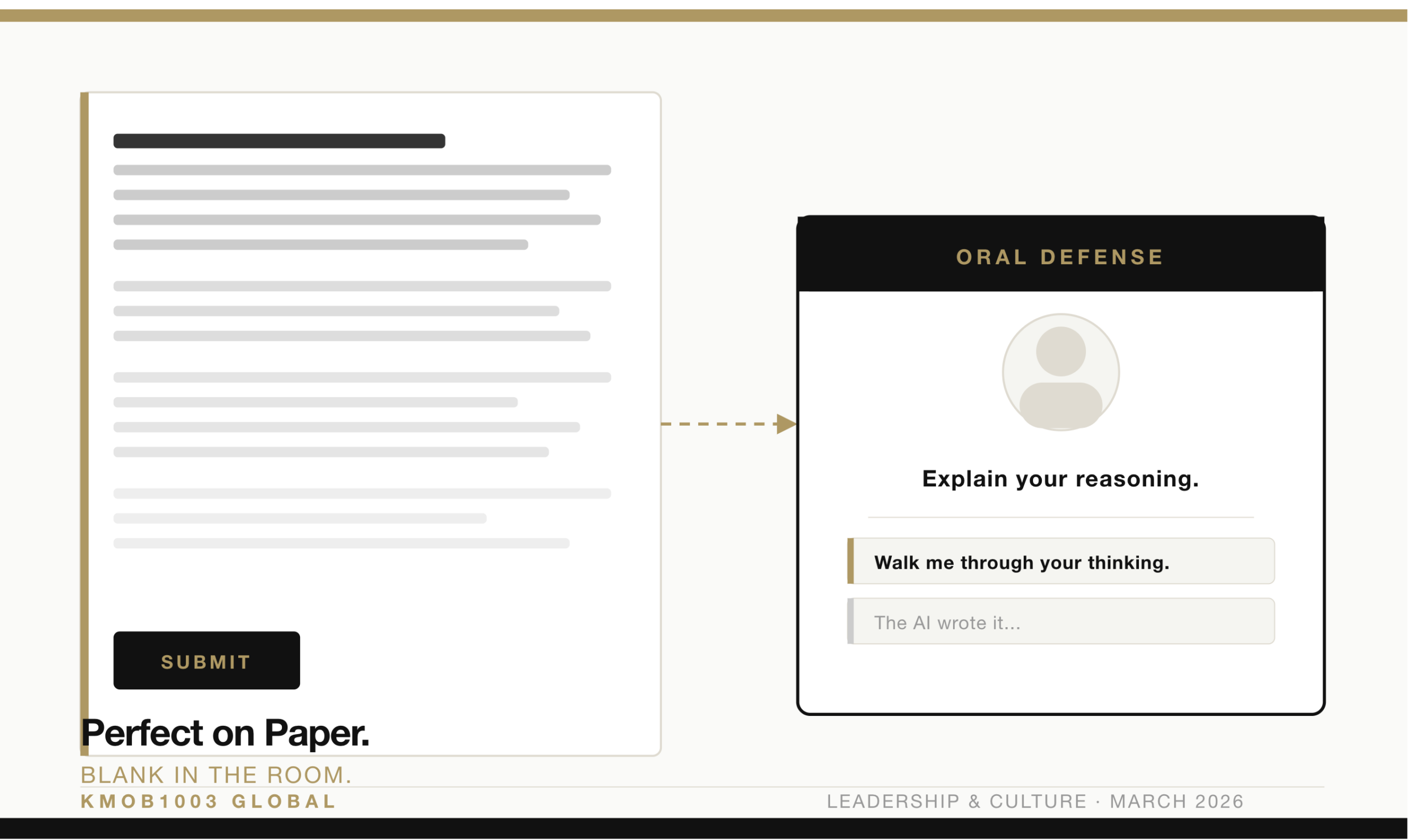
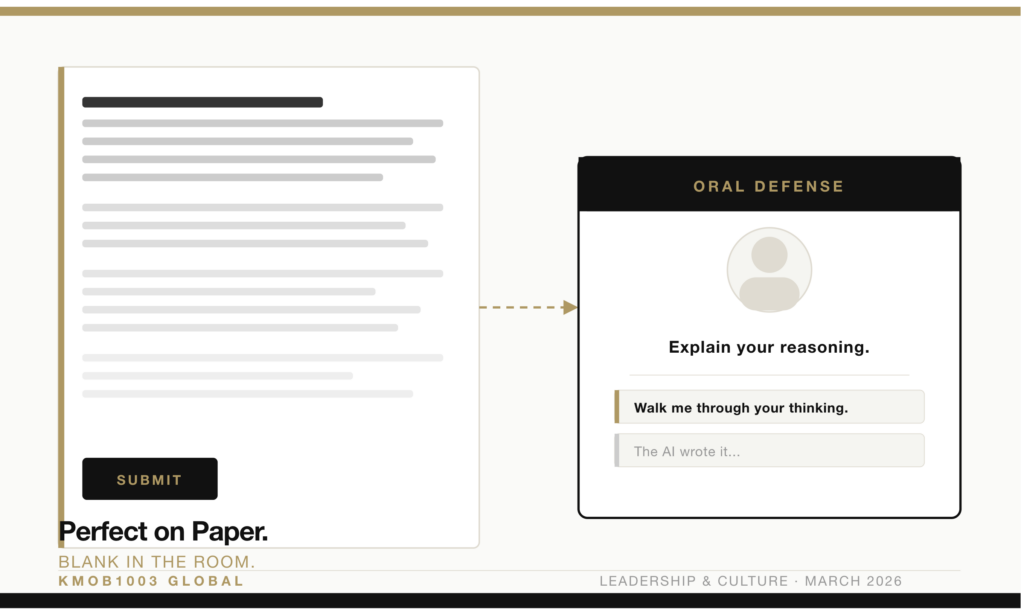
There are no laptops in the room. No phones. No notes of any kind. Just a student, an instructor, and a question that cannot be outsourced. It is called an oral defense — and a growing number of educators are bringing it back not to catch cheating, but because something more fundamental is being lost. The assignment comes back perfect. Then the follow-up question lands. And the silence that follows tells the whole story.
Perfect on Paper Blank in the Room — KMOB1003 Global Media
KMOB1003 Global Media | The room is the exam. It always was.
The Problem Is Not Cheating
Educators across engineering programs, humanities seminars, and business schools are witnessing the same pattern. Written assignments come back flawless. Grammar clean. Arguments structured. Citations correct. Then the professor asks a follow-up question. Silence. Not hesitation. Silence. The kind that confirms the work was produced but not understood.
One professor put it plainly: “Students are actually losing skills, losing cognitive capacity and creativity. That’s not why we’re doing this to prevent cheating — we’re doing this because something real is disappearing.” That statement is not about academic integrity policy. It is an institutional observation about what happens when the friction of thinking is removed from the process of producing.
AI did not create the tendency to optimize output over understanding. That has always existed. What it did was remove every obstacle that used to slow it down — and in doing so, made it easier than at any point in history to generate work that looks like thinking without any of the thinking behind it.
This Is Already In Your Boardroom
Here is the part that should land hard for anyone who leads a team: this dynamic is not a future problem. It walked in during the last hiring cycle. It sat in the last strategy review. It sent a report last Tuesday that looked exceptional — well-structured, confident, data-rich — and then could not answer a single question about the reasoning behind it when pressed.
The oral defense is not a classroom invention. It is what happens every time a leader says “walk me through your thinking” and the room hesitates. It is what happens when a board member pivots off-script and the team has no answer that was not already in the deck. It is what happens in an interview when the candidate’s portfolio is immaculate and their explanation of it is hollow. The document was never the point. The thinking behind it was.
The most honest question a leader can ask right now is this: on your team, who can be put in the room and trusted to defend the work? Not present it. Defend it. Answer the follow-up. Hold the line when the slide deck is closed and the real conversation begins. That number — however large or small it is — is a direct measure of the health of the thinking culture inside your organization.
KMOB1003 | Intelligence Library
Build the thinking. Own the room.
The leadership and cognitive performance canon — available in audio for the operator who moves.
Audible brings the full canon to every commute, workout, and field session.
The Burden Being Carried — And By Whom
There is a conversation that is not happening loudly enough. Educators are being asked to solve a problem that technology companies built, that employers benefit from, and that society handed entirely to the classroom to fix. A professor redesigning their full assessment model — building oral defense schedules for 70 students, training teaching assistants in Socratic questioning, running workshops on evaluating understanding rather than output — is doing work that HR departments, hiring managers, and executive teams should also be doing. But largely are not.
The question worth asking in every boardroom is this: are we preparing people to think, or are we only rewarding them for producing? Because if the answer is the latter, the classroom cannot carry that weight alone. And eventually the gap surfaces in the meeting where it matters most — the one with no slides, no preparation time, and no room to hide behind a well-formatted document.
This is not a criticism of any generation. It is a structural observation. When systems reward output without requiring understanding, people optimize for output. That is rational behavior responding to rational incentives. Changing the outcome requires changing the incentive — and that is a leadership decision, not an educational one.
Fighting Fire With Fire — The Right Way
Not every response to this challenge involves removing technology from the equation. Some of the most instructive approaches are using AI to raise the standard rather than replace the human behind it. At one major business school, a professor built an AI-powered oral examiner using ElevenLabs — the same voice AI platform that sits inside the KMOB1003 technology stack — to conduct adaptive, live conversations with students as part of their final exam.
The system asks follow-up questions based on each student’s answers. It detects hesitation. It probes for understanding, not just the presence of correct information. His conclusion after running it: “I don’t trust written assignments anymore to be the result of actual thinking.” That is not a rejection of AI. It is a more sophisticated deployment of it — using intelligence to verify intelligence, using the tool to confirm that the person behind the tool is still engaged, still reasoning, still present.
For business leaders, this is the model worth studying. Not banning AI from your organization — that window has closed — but building cultures where AI is a starting point and human accountability for the thinking is non-negotiable. Where the question “did you write this?” is replaced by the more useful question: “can you defend it?”
KMOB1003 | Creator Infrastructure
Own your voice. Control the signal.
The same AI voice platform being used to raise the standard in classrooms and boardrooms worldwide. This is the infrastructure of presence.

The Operator Advantage Hiding In Plain Sight
There is something else worth noting from what educators are observing. The oral format does not just expose weakness — it reveals depth that written formats routinely miss. The quiet professional who never dominates a group setting. The analyst who processes slowly but thinks precisely. The team member who never leads a meeting but can explain every decision they have made with complete clarity when asked directly. Those are your operators. They exist in every organization and are routinely undervalued by systems that only measure visible production.
The oral defense applied to business is simply this: create the conditions where people are required to explain their reasoning, not just present their conclusions. Make it a regular part of how work gets reviewed. Not as performance. Not as pressure for its own sake. As a basic accountability standard for everyone in the room, at every level — including the top of it.
And if this conversation is landing — if you recognize this dynamic in your team, your hiring process, or your own leadership practice — The Culture Docent has already gone there. EP 23: Don’t Take It Personal: How to Receive Feedback Without Defensiveness is the companion piece to everything in this post. Before you can defend your work in the room, you have to be able to receive what the room gives back. Dr. Takeisha Carr goes there directly. Watch EP 23 here →
KMOB1003 Global Signal
In 2026, the ability to produce something that looks like thinking is no longer a differentiator. What is rare — genuinely rare and increasingly valuable — is the ability to sit across from someone and defend the work. Do the thinking. Own the work. Be ready for the question. The room is the exam. It always was.