
KMOB1003 Global Protection Partner

KMOB1003 Intelligence | Mind, Power & Reinvention
AI is not just deleting roles. It is confronting identity. The deeper crisis is not technological displacement alone, but the perception that what was practiced for years was the only possible self.
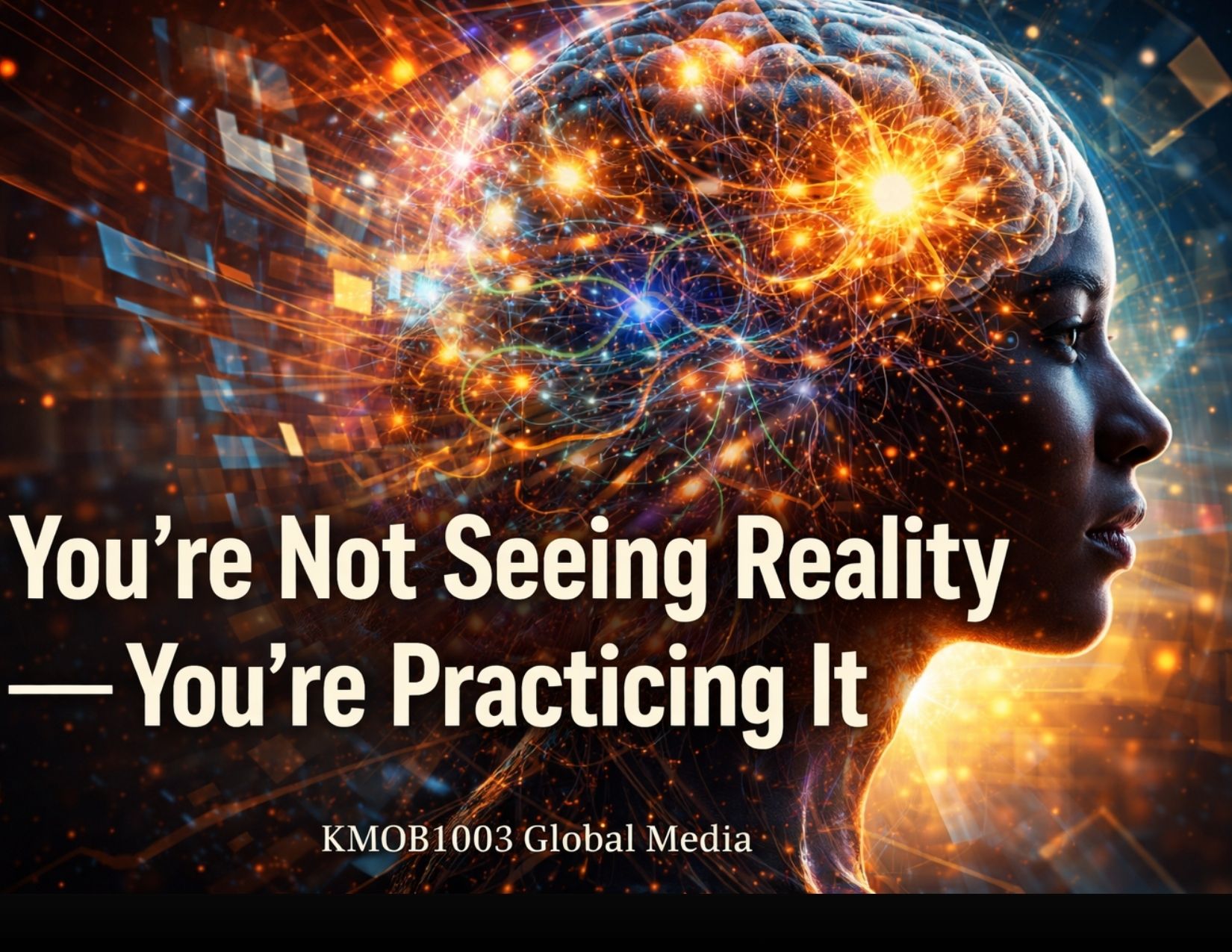
Your brain is not a camera. It does not passively record the world and hand you reality in a clean, objective stream. It predicts, edits, fills in gaps, and assigns meaning before you ever call something a fact. That insight is more than neuroscience. In an era defined by automation, AI, and collapsing career certainty, it may be one of the most important survival frameworks of this decade.

KMOB1003 Global Media feature image | Perception, AI, and the reconstruction of identity.
I. The Brain Is Not a Camera
Neuroscience calls it predictive processing. The brain builds a working model of what it expects the world to be, then compares incoming data against that model. If there is a mismatch, it updates. If there is no mismatch, it moves on. What feels like direct perception is actually prediction plus correction. Your senses deliver fragments. Your brain assembles the experience. You do not encounter reality in a raw, untouched state. You experience a constructed version of it.
This explains why objectivity is harder than most people think. Two people can hear the same song, read the same headline, or lose the same job market at the same time and still walk away with entirely different meanings. Memory, emotion, culture, and learned expectation shape what the mind treats as signal. Even time itself is edited. What feels like “now” is slightly delayed, processed, and stabilized before it reaches awareness.
For readers building a deeper intellectual archive around perception, adaptation, and the architecture of reinvention, explore the long-view reference shelf through Amazon Books and track the broader emotional atmosphere of this era through Amazon Music Prime.
II. AI Is Deleting More Than Jobs
This is where the conversation becomes urgent. Across media, design, admin, education, support, production, and knowledge work, AI is not merely changing workflows. It is destabilizing identities built over years of training. People went to school for these careers. They took on debt for them. They arranged their confidence, habits, and social value around them. When the market begins to erase or compress those roles, the shock is not only financial. It is neurological and psychological.
The most common language is revealing: “This is all I know.” “It’s too late.” “I can’t start over.” Those statements feel absolute because the brain has practiced one model of selfhood for so long that it begins to mistake familiarity for truth. But that is perception, not destiny. It is the mind defending the strongest pattern it has built so far.
III. Why Some People Adapt Faster
The difference between paralysis and reinvention is often not intelligence. It is valuation. The brain marks what matters through repetition and reward. Dopamine is not simply pleasure; it is a signal that says this is worth returning to. When a person has spent years being rewarded for one skill set, one title, one form of recognition, the brain builds deep loyalty to that pattern. When the market changes, the person is not only losing income. They are losing the reward map that told them who they were.
This is also why one person reads a new book every week while another avoids reading completely. One mind has learned to associate reading with progress, identity, and reward. Another has learned effort without payoff. Preference is not always “natural.” It is often trained. What you love, what you avoid, and what you become good at are shaped by how your brain has learned to assign value and build perception around that activity.
KMOB1003 | Creator Infrastructure
Build the voice. Control the message.
For creators translating thought, analysis, and lived experience into premium narrative distribution, control of the signal remains the advantage.
Operational Mastery via ElevenLabs.
IV. The Elite Performer Lesson
The best quarterbacks, pianists, chess players, opera singers, and composers offer a different model of what mastery really is. They are not simply reacting faster. They are seeing more usefully. The quarterback predicts coverage before the snap. The grandmaster recognizes structure before calculation. The pianist hears the phrase before touching the keys. Their advantage is not mystical. It is a refined internal model built through repetition, correction, and reward. They are running a better simulation of the same world.
That matters now because adaptation under AI requires the same mechanism. The people who will move forward are not necessarily the people with the longest resumes. They are the people who can rebuild an internal model quickly, learn new value signals, and tolerate the discomfort of becoming a beginner again. In other words: they can retrain perception.
V. It Is Not Too Late — But It Is a Rewiring
When people say it is too late, they usually mean the old identity feels more real than the emerging one. But the brain is adaptive. Neuroplasticity does not disappear because the market moved. New pathways form through repeated, meaningful exposure. The way forward is not force. It is intelligent retraining: small wins, lower resistance, repeated contact, and enough reward for the brain to mark the new direction as valuable.
Learn one tool, not twelve. Build one new competency, not an imaginary perfect future. Read ten pages. Watch one tutorial. Ship one new asset. Let progress become visible. Let effort become familiar. Over time, what felt foreign becomes usable, what felt unusable becomes skill, and what felt like survival becomes selfhood. The person is not starting from nothing. They are building from practiced intelligence into a new architecture.
The deeper KMOB1003 signal is this: AI may delete roles, compress industries, and challenge everything people thought was stable. But it cannot erase the brain’s ability to rebuild meaning. The danger is not only automation. The danger is believing the first model of yourself was the final one. It wasn’t. It was simply the version you practiced longest.
KMOB1003 Global. The next era will belong to people who understand that perception is trainable, identity is reconstructable, and reinvention begins the moment you stop mistaking familiarity for fate.


Sovereign Movement
Travel logistics via Southwest.

Strategic Movement: Travel logistics for the high-signal environment via Southwest.
Travel Logistics by Southwest.