
KMOB1003 Global Protection Partner

KMOB Intelligence | Women’s History Month
There are moments when culture expands, and then there are moments when that expansion is finally priced correctly. What the WNBA achieved this week is not growth. It is alignment.
Early Wednesday morning, after more than one hundred hours of negotiations across eight days, the league and its players’ union reached an agreement in principle on a new collective bargaining agreement. While the formal term sheet is still being finalized, the outcome is already clear: the WNBA is entering an era of million-dollar players, with top contracts projected to reach $1.4 million and average salaries expected to exceed $585,000.
For a league approaching its 30th season, this is not an evolution. It is a market correction.
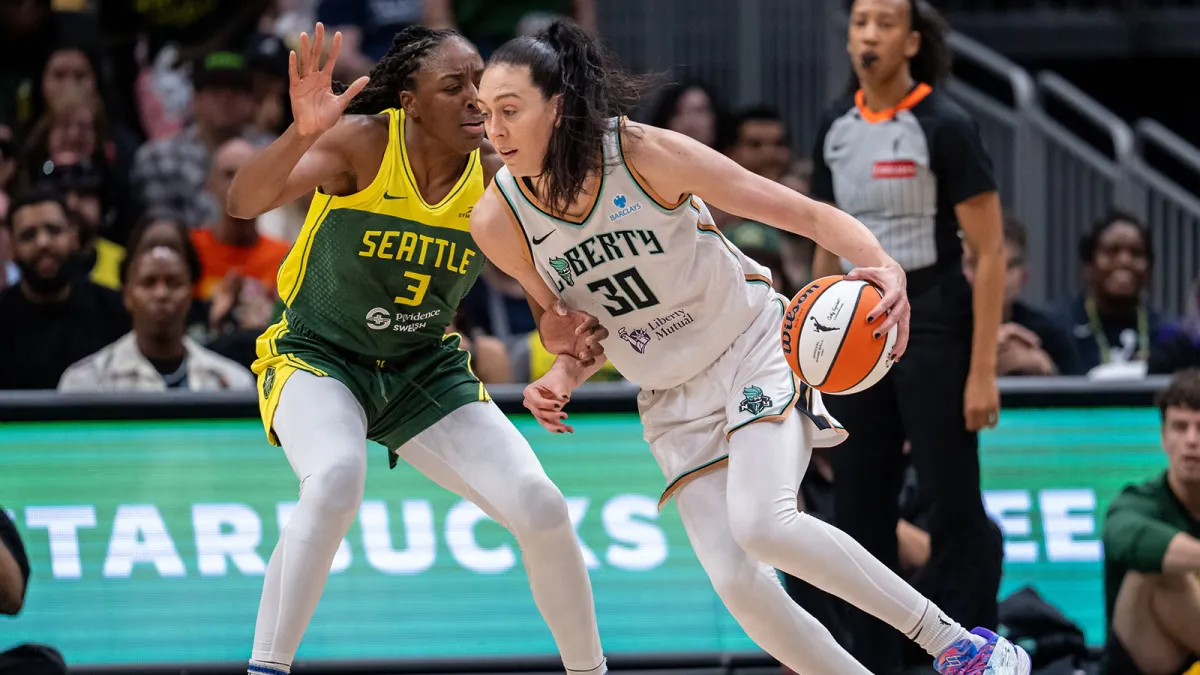
 Nneka Ogwumike and Breanna Stewart at the center of the WNBA’s transformational CBA moment.
Photo credit: ClutchPoints.
For years, there existed a visible incongruity between the WNBA’s global cultural signal and its internal financial ledger. The league expanded across every measurable surface—attendance, viewership, sponsorship, and cultural influence—while its compensation structure remained tethered to an earlier valuation model. The athletes were no longer just players. They were brands, institutions, and global ambassadors. The numbers, however, had not caught up to that reality.
The players recognized the misalignment before the system did.
When Alysha Clark said, “What we were giving to this league and what we were getting back didn’t match,” she was not describing frustration. She was identifying a valuation error. The athletes understood that the asset had appreciated, and the structure surrounding it had failed to update accordingly. That level of clarity is not emotional. It is architectural.
KMOB Intelligence | Creator Infrastructure

For creators building signal, voice remains infrastructure. KMOB1003’s creator stack includes tools designed for scale, clarity, and control.
Seventeen months ago, the players opted out of their previous agreement, initiating a long-game strategy that required both patience and precision. The negotiations that followed were not symbolic gestures but sustained, technical engagements that addressed revenue sharing, salary structure, housing, and the broader framework of player autonomy. The final agreement, reached at approximately 2:20 a.m. after another ten-hour session, reflects not a concession but a recalibration.
For the first time, player salaries are tied to a meaningful share of league revenue, allowing compensation to scale alongside growth rather than lag behind it. The salary cap, projected around $7 million, becomes a dynamic reflection of the league’s expansion rather than a static constraint. Minimum salaries rising toward $300,000 further establish a new baseline for professional standards within women’s sports.
This is not generosity. It is alignment.
To understand the weight of this moment, it is necessary to revisit the structure that preceded it. Under prior agreements, many players were required to extend their seasons overseas in order to reach a level of compensation that matched their professional status. The global market became not a luxury expansion but a necessity. The offseason was, in reality, a continuation of labor.
That system has now been disrupted.
In 2022, Nneka Ogwumike articulated the foundation of this shift when she said, “We are not just asking for more; we are asking for what is right based on the growth we have created.” Four years later, her reflection on the current agreement—“We stayed with it until it did”—confirms the completion of that trajectory. The throughline is not demand. It is endurance.
This moment does not exist in isolation. It sits within a broader cultural recalibration that has defined the past several weeks. At the Academy Awards, the performance of Sinners demonstrated how artistic authority operates when it is left intact. Miles Caton and Raphael Saadiq did not reinterpret the blues for accessibility; they presented it with its full historical weight. It was not softened for the room. The room adjusted to it.
Misty Copeland’s return to the stage carried a similar signal. Appearing after retirement and recent hip surgery, her performance was not framed as recovery but as command. Earlier this month, we also revisited the work of Ann Lowe, whose brilliance shaped American style while institutions failed to compensate or credit her properly. The same principle runs through all three stories: invisibility is a structural choice made by institutions, while authority is a choice made by the creator.
The WNBA players did not wait for institutional validation. They did not rely on narrative momentum to justify their value. They built the league’s cultural infrastructure in real time and then negotiated until the financial architecture reflected that reality.
This is where the conversation extends beyond sport. For decades, industries built on cultural production have operated within similar incongruities, where visibility expands faster than compensation and influence outpaces ownership. The correction seen in the WNBA represents a shift in how that imbalance is addressed. It establishes a precedent where growth is not merely celebrated but quantified, structured, and returned to the individuals responsible for creating it.
The implications are immediate. With expansion teams entering Toronto and Portland, and more than eighty percent of players entering free agency, the league is moving into a phase defined by leverage, mobility, and strategic positioning. Players now operate within a system that recognizes their value not as promise, but as established fact.
For fans, the impact will be visible in the game. For the industry, the impact will be structural. The most important detail, however, is not the size of the contracts or the scale of the salary cap. It is the principle underlying them. The players identified the incongruity, sustained the pressure required to address it, and refused to exit the process until alignment was achieved.
They did not adjust to the room. They repriced it.
And once a room has been repriced, it does not return to its previous valuation.