
KMOB1003 Global Protection Partner

KMOB Intelligence | Culture Audit
Red carpet glamour is a predictable dialect. Glossy strands. Taut updos. An obedient, rhythmic bounce calibrated for Eurocentric lenses.
For decades, the industry has accepted this as the baseline for “Prestige.” The subtext was never hidden: to look expensive was to look unthreatening. To be “Red Carpet Ready” was to perform a gentle, silent retreat from Blackness.
The 2026 awards season ended that conversation.
The “Quiet Contract” of Hollywood beauty—the one that traded cultural specificity for professional proximity—has been shredded. The cast of Sinners did not arrive at the Academy Awards to audition for the tradition. They arrived as its new architects. Through a high-stakes, uncompromising embrace of braided geometry, Ryan Coogler’s collective transformed the red carpet into a site of cultural refusal.
It wasn’t a trend. It was a return.
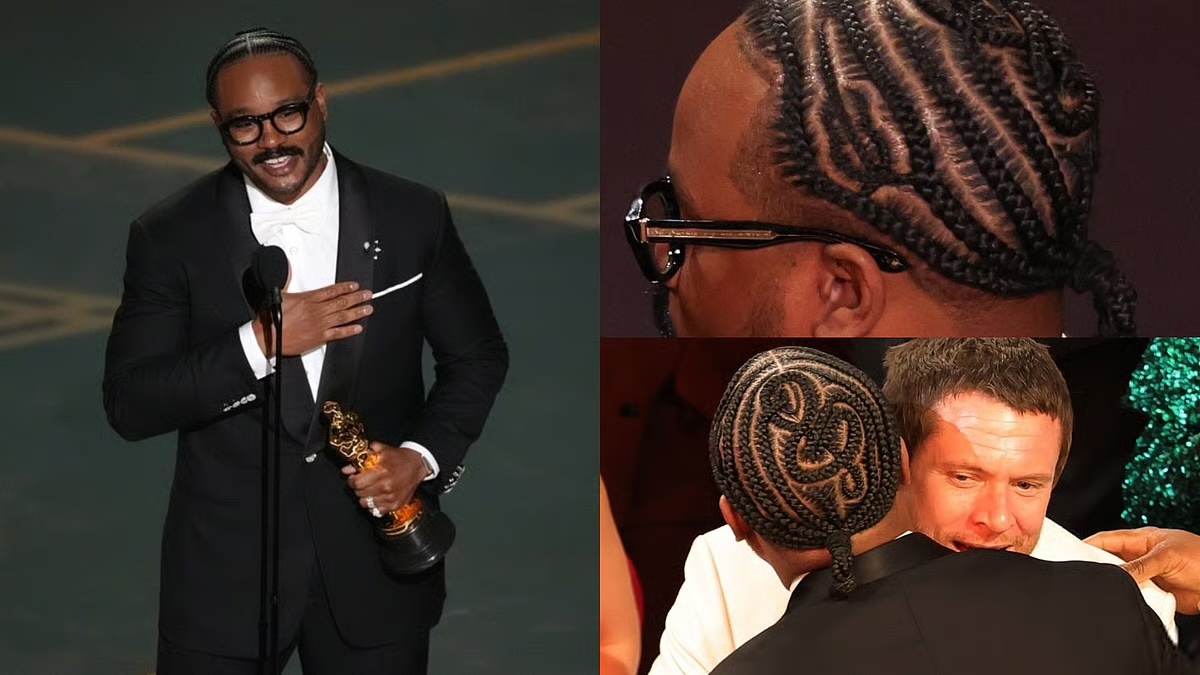
Ryan Coogler wearing braided guitar and treble clef design, Academy Awards 2026.
Photo credit: Cinema Express.
The Sinners Ledger
The record is now part of the archive: 16 Oscar nominations. Four Academy Awards. Best Actor. Best Original Screenplay. Best Original Score. Best Cinematography.
But the technical wins were secondary to the visual ones. Before Michael B. Jordan took the stage, before Ludwig Göransson’s score was validated, the statement had already been made in the scalp. Director Ryan Coogler accepted his Oscar with intricate cornrows shaped into a guitar and treble clef—mapped directly into the scalp. A quiet tribute to the blues language running through Sinners, carried without explanation.
The Technical Labor: Experience Architecture
The industry still calls it styling. The work says otherwise. Braiding is a technical discipline of geometry, anatomy, and physical endurance. It is performed in the quiet of hotel suites and backstage dressing rooms, hours before the first flashbulb ignites.
When Wunmi Mosaku prepared for the London leg of the press tour, the directive she gave to international celebrity stylist Dionne Smith was untranslated: “I want something that talks to the ancestors.” Smith did not deliver a look. She delivered the work, strand by strand.
For the BAFTAs, she threaded gold rings into Mosaku’s braids so the light would catch before the flash did—a detail mirrored in the movement of her gown. In North America, Araxi Lindsey maintained that continuity. In Los Angeles, Evalyn Denis spent five and a half hours on Miles Caton’s stitch braids. It requires an understanding of tension, a sense of geometry, and time most people are not willing to give.
The Invisible Map: Adornment as Intelligence
To see a braid on the Academy Awards stage is to see a return to the Invisible Map. During the Middle Passage and throughout enslavement, braids carried more than form. They held direction. Memory. Survival. Patterns moved quietly, but they moved with purpose.
When Ryan Coogler wears a braided clef, it sits inside that lineage. Not as reference. As continuation. Sinners is a film rooted in music, folklore, and memory passed through generations. The hair choices did not sit outside that story. They carried it. A braided crown at the Oscars does not adjust itself to the room. No softening. No translation. Nothing about it asks to be accepted.
The Final Audit
Braids are timeless. You can see it in the way they hold the face. In the way they refuse distraction.
When the table doesn’t have a place for your tradition, you don’t change your hair. You change the room.


Global Mobility Partner