

KMOB1003 Global Intelligence | Trust Audit
A Florida therapy case raises deeper questions about vulnerable lives, structural trust, and what happens when oversight fails the people who need protection most.
Trigger Warning: This article references alleged abuse involving a nonverbal autistic child.
Authority is supposed to mean safety.
Therapists. Teachers. Doctors. Producers. Managers.
These are the people society places closest to our most vulnerable lives. Parents trust therapists with their children. Young artists trust producers with their dreams. Communities trust professionals with their care, their growth, and their futures. But every so often a story emerges that forces us to confront a brutal truth: authority and integrity are not the same thing. And when authority loses sight of its responsibility, trust stops feeling like shelter and starts feeling like danger.
The Case That Shook a Florida Community
In Palm Beach County, Florida, therapist Reylan Garnier has been charged with felony child abuse after surveillance footage allegedly showed him striking a nonverbal autistic child during a therapy session. A Palm Beach County judge later set bond at $7,500 and ordered him to have no contact with the child. Police said Garnier turned himself in after an investigation by the Lake Clarke Shores Police Department.
According to authorities, surveillance footage allegedly showed Garnier throwing a ball and a shoe at close range, striking the child multiple times with objects, grabbing the child abruptly, and escalating the encounter in ways investigators described as deeply disturbing. The child’s mother said she noticed bruising and marks on her son after the session. What she discovered when she reviewed the footage was not care. It was harm.
Viewer Discretion Advised
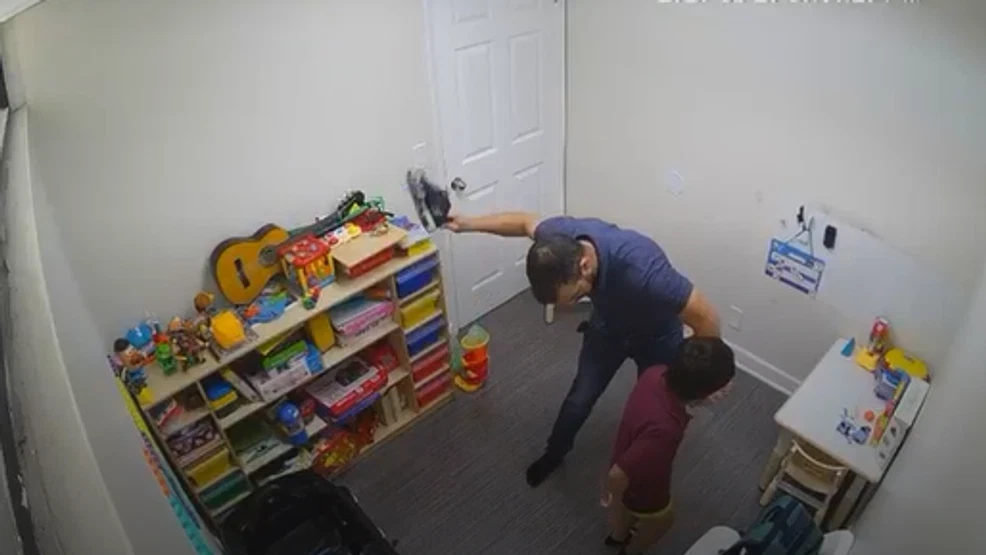
Surveillance image from Maximum Achievers referenced in the Palm Beach County investigation involving alleged abuse of a nonverbal autistic child during a therapy session.
Image credit: Maximum Achievers surveillance footage
A Mother’s Worst Fear
The child’s mother, Diana Hernandez, told local reporters that she reported the incident to both the therapy center and police after noticing bruising and a bite mark on her son’s back. Her words captured the dread that sits inside every caregiving system:
“It’s horrible. I can’t describe it. That’s my biggest fear, to see my son get hurt and not be there to protect him.”
For families raising children with disabilities, therapy centers are supposed to function as places of progress and possibility. They are supposed to help children communicate, stabilize, and grow. That makes the trust relationship profound. Parents are not just signing paperwork. They are handing over the most vulnerable parts of their lives.
The Most Vulnerable Among Us
Advocates have long warned that children with disabilities are more vulnerable to abuse because they often rely heavily on caregivers and may have limited ability to report mistreatment in conventional ways. When a child is nonverbal, the risk intensifies. They may not be able to describe what happened. They may not have the language to explain their fear. They may rely entirely on adults to recognize changes in their body, their behavior, and their silence. Bruises. Withdrawal. Distress. Stillness. These become the language of alarm.
KMOB1003 Audio Intelligence Partner
Build the Listening Archive
Long-form listening remains one of the strongest tools for understanding trauma, development, neurodiversity, and care.
When Authority Is Misused
In statements to reporters, Garnier expressed regret and described losing control. But the deeper issue extends far beyond one explanation, one person, or one termination meeting. The real structural question is this: What happens when someone placed in a position of trust forgets the purpose of that trust?
Because this pattern is not confined to therapy rooms. We see it when coaches exploit athletes. When supervisors abuse employees. When caregivers mistreat the elderly. When producers manipulate young artists who enter the business excited, inexperienced, and willing to do anything for a chance. Excitement and vulnerability often arrive at the same door — and not everyone who opens that door deserves the trust they are given.
The Camera That Changed the Story
In this case, accountability came from something simple: documentation. A parent asked questions. A camera existed. Evidence surfaced. Without the footage, the alleged abuse might never have been believed in full. The child could not narrate the event. The video became the record. In moments like this, documentation becomes the voice for someone who cannot speak for themselves.
KMOB1003 Perspective
Authority is meant to protect. Not dominate. Not intimidate. Not harm. The most important test of power is not how it behaves when people are watching. It is how it behaves when someone believes they are beyond scrutiny. And when trust fails, communities are left to do the work institutions were supposed to do from the beginning: witness, document, and demand accountability. If journalism explains the facts, poetry explains the weight those facts carry.
Spoken Word Signature
The Weight of Trust
Trust is a quiet thing. It doesn’t arrive with applause. It doesn’t announce itself with power. It is handed over softly—by parents at a doorway, by artists in a studio, by children who cannot yet explain what they feel.
Trust is the invisible contract between vulnerability and responsibility. And when that trust is broken, the sound it makes is not loud. It is the silence of someone who cannot find the words. The silence of a child who cannot speak. The silence of a young dreamer who believed the person in the room was there to protect them.
Authority was never meant to be a shield for harm. It was meant to be a shelter. A place where strength stands guard over the fragile. But power can forget. It can forget why it was given. It can forget who it was meant to serve. And when it does, it becomes something else entirely. That is why stories matter. Because stories break silence. They remind the world that trust is not ownership. It is a promise. And every promise carries weight. Especially when it is placed in the hands of those who cannot defend themselves.
KMOB1003 Media Infrastructure Partner


