

KMOB1003 Global Intelligence | Narrative Audit
Apollo put twelve men on the Moon. All twelve were white. All twelve were American. That is not a footnote. That is the baseline.
And now NASA is returning—not under the name Apollo, but Artemis. The twin sister. The lunar counterpart. The structural correction that signals something deeper than a rebrand: a shift from moment to machinery, from myth to infrastructure, from narrow access to expanded authorship.
Because Artemis is not a sequel. Artemis is a rewrite.
The Apollo Truth: A Frontier Reserved
Apollo is remembered as victory, engineering, and national power. It is also a record of who the world trusted to represent humanity when the stakes were absolute. Twelve astronauts walked on the Moon between 1969 and 1972. Twelve men. No women. No Black astronauts. No global coalition. No expanded pipeline. The lunar surface was not “the future.” It was a gated room. Artemis begins where that story ends—not with nostalgia, but with design.
Why “Artemis” Is the Name That Changes the Frame
In Greek mythology, Apollo is the god of light, prophecy, music, and order. Artemis is his twin sister: goddess of the Moon, the wilderness, and the hunt. NASA could have named its return Apollo II. It didn’t. It chose the twin.
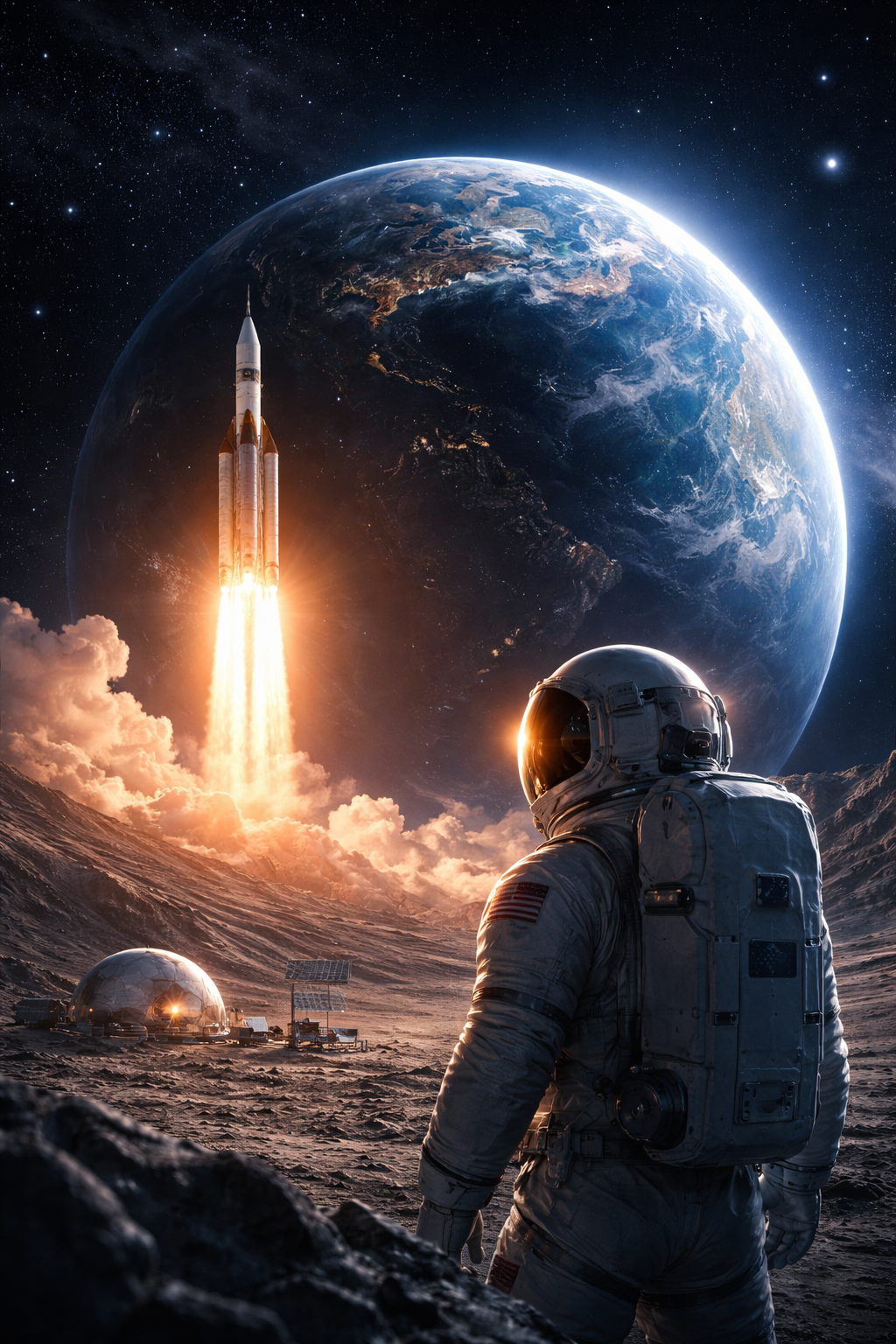
That choice matters because it signals a different posture: Apollo was a landing-and-leave era. Artemis is a return-and-build era. The Moon is no longer treated like a monument you visit. Under Artemis, it becomes something else: a logistics environment. A place where systems need to be permanent, repeatable, expandable. Architecture, not a stunt.
KMOB1003 Audio Intelligence Partner

Build Your Listening Discipline
Access the global literary canon and premium investigative media. Stewardship is a continuous practice—even in motion.
The Pioneers: Artemis II Is Where the Rewrite Starts
Before the next footprint, there is the flight that reopens deep space. Artemis II is the first crewed mission to travel beyond Earth orbit in over half a century. This is the crew shaping the narrative shift: Christina Koch — Mission Specialist; Victor Glover — Pilot (First Black astronaut to fly to the vicinity of the Moon); Reid Wiseman — Commander; Jeremy Hansen — Mission Specialist. This is not just a “representation headline.” It’s a strategic signal: the frontier is being reopened with a wider definition of responsibility.
Expanding the Talent Pipeline
In high-stakes environments, the greatest weakness is never the hardware. It’s the pipeline. Artemis is not simply “inclusion.” It is a modernization of the talent model. A quiet acknowledgment that the most complex missions require access to the full spectrum of human intelligence—technical, cultural, operational, psychological. When you expand who gets to operate at the frontier, you expand the future itself.
Apollo Was Camping. Artemis Is Architecture.
Apollo was engineered to arrive. Artemis is engineered to remain. NASA’s focus is moving toward the lunar South Pole, where shadowed craters are believed to hold water ice—an asset that changes the Moon’s role entirely. Water is not just hydration. Water is chemistry.
[Image of hydrogen fuel cell]Split it and you get oxygen (breathing) and hydrogen (fuel). That transforms the Moon from a destination into a deep-space logistics hub—a place that can support longer missions, sustained operations, and eventually, the next frontier beyond it. This is why Artemis isn’t “going back.” It’s building forward.
Wearable Infrastructure: The Suit Is the System
Luxury is performance under pressure. The new era of exploration is powered by wearable infrastructure: suits that function less like uniforms and more like complete life-support ecosystems. Mobility. Thermal protection. Dust resistance. Dexterity. Tool integration. Vision systems. Lighting. Communications. Safety redundancies. Not symbolism. Systems. Because the people stepping into this new chapter deserve equipment designed for capability, not ceremony.
KMOB1003 Perspective: The Moon as Infrastructure
Artemis is where myth meets logistics. The name is ancient, but the shift is modern: from a Moon that once served as a theater of national dominance to a Moon that is becoming a platform—an operational space where presence, continuity, and coalition matter. And for Black futures, the implication is clear: Doors that were structurally closed are being rebuilt in real time. Not as permission. As necessity. Because the next era of exploration will not be sustained by nostalgia. It will be sustained by the strongest infrastructure—and the strongest infrastructure is built with the broadest talent.
The journey back to the Moon did not begin with Artemis—it began with Black brilliance that calculated the impossible long before the world learned their names.
Spoken Word Signature
We Were Always Written in the Stars
We were told to look down.
To keep our feet planted in the soil of other people’s expectations.
But somewhere between the cotton fields and the classrooms,
between the drumbeat and the launchpad,
between the poem and the propulsion system—
we kept looking up.
The sky was never empty to us. It was memory. It was navigation. It was possibility waiting for courage.
And now the same stars that guided our ancestors are watching us return the gaze. Not as visitors to the future, but as authors of it.
Because long before rockets rose from Florida’s coast, long before astronauts crossed the silent vacuum— we were already written in the stars.
