KMOB1003 Global Intelligence | Narrative Audit
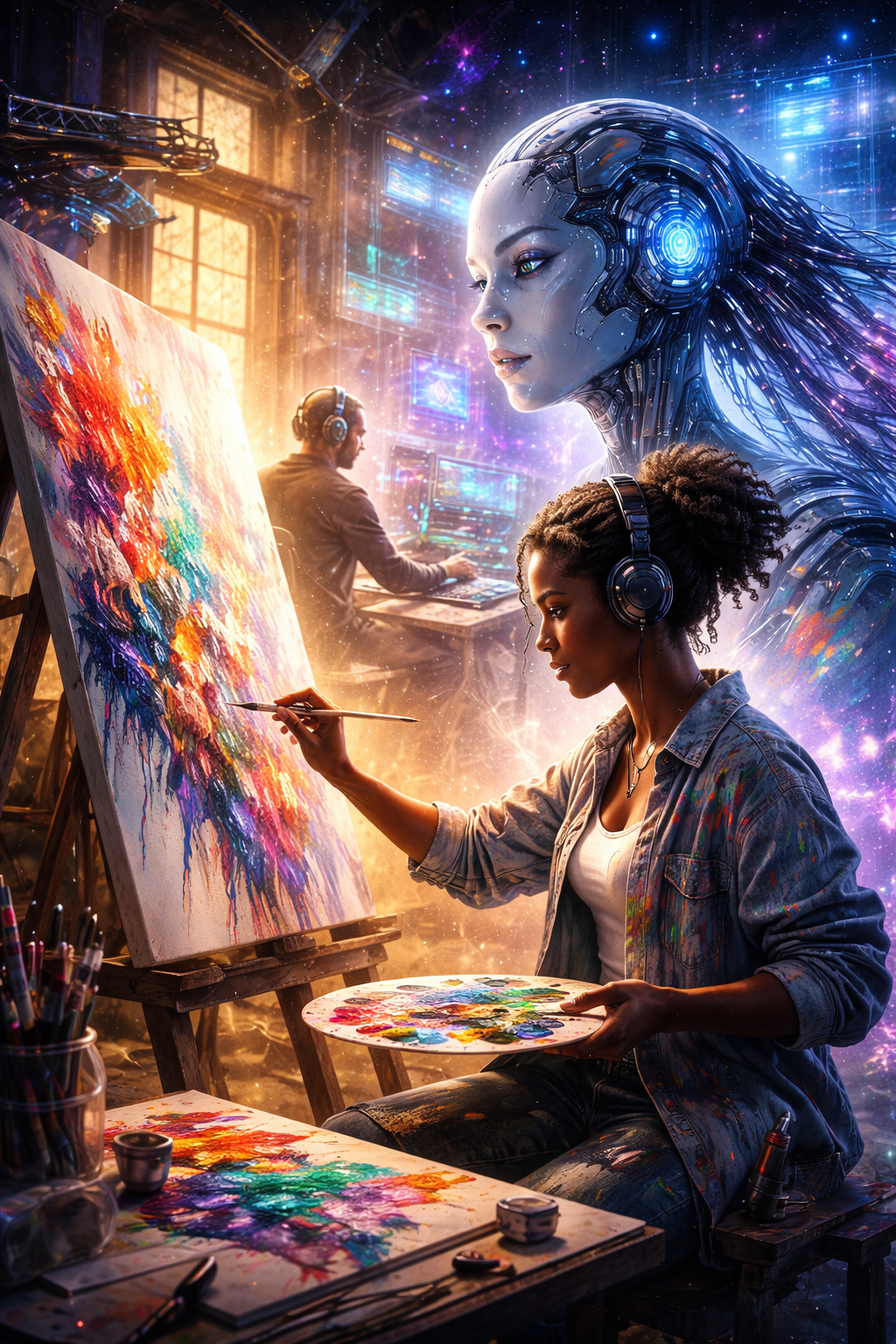
The machines can now paint. They can compose orchestral scores, generate album covers, and produce entire visual worlds in seconds. But the question shaking the creative economy in 2026 is no longer whether AI can create. The real question is: Who owns it?
This week, the U.S. Supreme Court quietly stepped away from one of the most consequential creative disputes of the digital era, declining to hear the case of Stephen Thaler. The ruling leaves a stark line in the sand: Art created solely by machines cannot be copyrighted. For now, copyright belongs to humans.
The Legal Audit: Why Human Choice Matters
The court’s decision reinforces the “Human Authorship” requirement. When Stephen Thaler attempted to copyright an artwork titled “A Recent Entrance to Paradise,” generated entirely by his “Creativity Machine,” the Copyright Office stood firm. Without a human mind at the center of the creative choice, the work enters the public domain immediately upon generation.
Style as Labor: The Artist Rebellion
While Thaler fought for machine rights, creators are fighting for labor rights. AI models are trained on billions of images—often scraped without consent. When a machine replicates a style that took a human decades to refine, the concept of “originality” is being structurally devalued.
Artists like Greg Rutkowski, whose fantasy aesthetics were scraped so often his name became a common prompt, and Karla Ortiz, a concept artist for Marvel, have led the charge. Their argument is simple: This isn’t just about art; it’s about the unauthorized scraping of human labor. Comic artist Sarah Andersen joined the vanguard, suing AI firms over the alleged theft of her visual tone. In 2026, we are realizing that a machine can imitate a pattern, but it cannot live a life.
Sonic Signatures: Music’s High Stakes
The music industry is watching this legal line with intensity. Following the viral AI Drake and The Weeknd track in 2023, the threat of “voice cloning” has become an existential crisis for producers. AI can generate beats, vocals, and lyrics, but the Supreme Court’s refusal to hear the Thaler case suggests that synthetic tracks cannot be owned or protected in the same way human compositions are. Authorship remains the only asset that doesn’t depreciate in a synthetic market.
CapCut: Scaling the Human Signature
In response to automated aesthetics, creators are leveraging tools that allow for granular control. CapCut has emerged as a primary infrastructure for artists to reclaim their visual narrative. By using AI as an assistant—for smart captions or auto-reframing—rather than an author, creators scale their production while keeping their human signature intact.
Spoken Word Signature
The Ghost in the Code
They taught the machine to mimic the brushstroke.
To trace the curve of the melody until it felt like a memory.
But they forgot one thing:
A machine can calculate the pattern, but it cannot feel the hunger.
It can replicate the style, but it cannot survive the struggle.
Culture is not a calculation. It is a life lived.
