
KMOB1003 Global Travel Partner

Champions move globally. Stay where performance meets precision.
KMOB1003 Global Intelligence | Financial Architecture
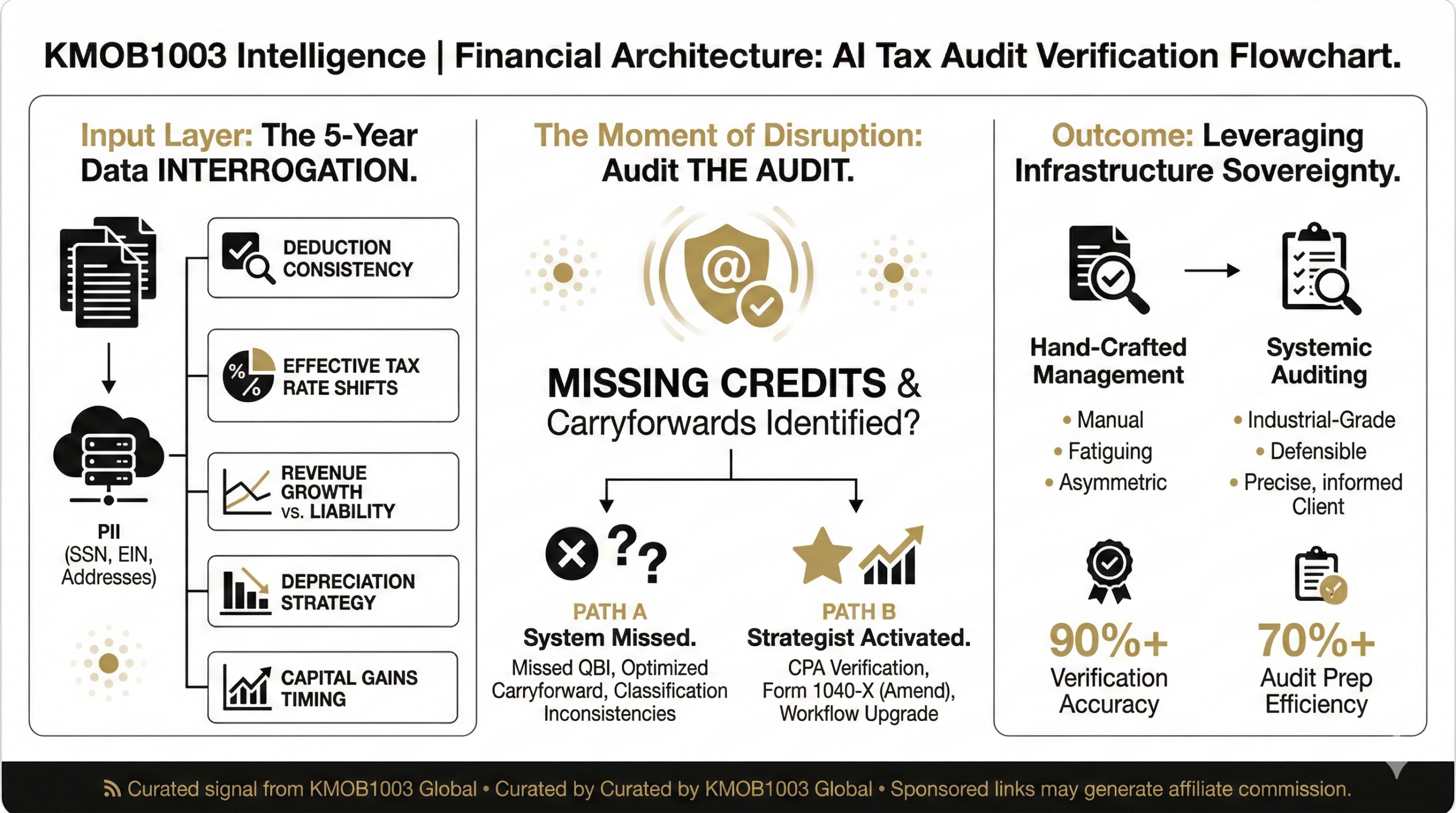
Audit the Audit: The New Frontier of Tax Leverage
Tax Season Has Changed — And AI Is Quietly Reshaping Power
For years, tax preparation was built on asymmetry.
You handed over documents.
Your CPA disappeared for weeks.
You signed where instructed.
And you hoped nothing was missed.
Now individuals, founders, media companies, and artists are uploading three to five years of tax returns into AI systems like ChatGPT and Gemini — not to replace professionals entirely, but to audit the audit.
That phrase is the whole shift.
Because once a client can verify the work, the old power dynamic collapses.
Let’s Be Clear: Firms Haven’t Been “Manual” for Years
The “calculator era” is long over.
Companies like H&R Block and CPA firms already run:
- enterprise tax engines
- automated compliance systems
- rule-update databases
- risk scoring and anomaly detection
- reconciliation tooling
The profession digitized a long a time ago.
What’s new is this:
The client now has a verification layer too.
And verification changes leverage.
What Actually Happens When You Upload 3–5 Years of Returns?
AI doesn’t just “explain a form.”
It zooms out.
It compares years simultaneously:
- effective tax rate shifts
- deduction consistency
- depreciation strategy
- capital gains timing
- business expense ratios
- estimated tax alignment
- revenue growth vs. liability growth
Traditional tax prep often optimizes within a single year.
AI patterns across time — and flags what doesn’t make sense.
That’s not filing.
That’s intelligence.

The Moment That Changes Everything
Someone uploads three years of returns and asks:
“Were there any credits I qualified for but didn’t claim?”
AI flags:
- a missed credit
- an unoptimized carryforward
- a QBI deduction miscalculation
- depreciation not maximized
- classification inconsistencies across years
Then comes the quiet shock:
Thousands — sometimes tens of thousands — may have been left on the table.
At that point the question is no longer:
“Who prepared my taxes?”
It’s:
“Who was responsible for protecting my financial architecture?”
What You Do If You Discover a Major Miss
You don’t go to war. You go to process.
- Verify with a licensed CPA (or enrolled agent).
- Amend if warranted (Form 1040-X, or business equivalents).
- Rebuild the workflow so you’re not discovering this three years late.
- Upgrade the relationship from “preparer” to “strategist.”
Because once you’ve seen a miss, you realize the real risk:
Not error — blindness.
Will AI Make Mistakes?
Yes.
AI can misread incomplete uploads.
It can miss context you didn’t provide.
It can over-assume.
But here’s why this is spreading anyway:
Tax returns are structured documents.
Standardized forms.
Consistent logic.
Fixed math.
Pattern recognition in structured environments is where AI can be extremely strong.
And the analysis it can run is what feels unreal:
- instant recalculations
- multi-year anomaly detection
- scenario forecasting (revenue up 25%, what happens?)
- “what-if” structuring comparisons
- consistency checks across schedules and statements
It’s not magic. It’s scale.
The Real Friction: Privacy and Data Security
This is the biggest barrier to the shift:
Most people are uncomfortable uploading returns filled with PII — names, addresses, SSNs, EINs — into any cloud system.
Here’s the KMOB insight:
The real power shift accelerates when secure workflows become normal.
When analysis can happen privately — without data leakage fears — the “audit the audit” layer stops being niche.
It becomes standard.
The Strategy vs. Commodity Divide
This is where the industry splits.
Three tiers survive:
- Ultra-cheap compliance (fast filing, minimal advisory)
- Elite strategy (structuring, planning, negotiation, long-horizon optimization)
- AI-augmented operators (hybrid: machine-led discovery, human-led decisions)
The danger zone is the middle:
Moderately expensive, compliance-only firms — the ones charging premium rates for discovery and reconciliation without offering real strategy.
Because AI crushes discovery time.
And when discovery time collapses, the pricing model collapses with it.
The Regulatory Counter-Move: AI vs. AI
This isn’t just taxpayers getting smarter.
Regulators are modernizing too.
The same pattern recognition that helps a founder spot inconsistencies is also useful for identifying anomalies at scale.
That creates a “cold war” layer to tax season:
AI on the taxpayer side vs. AI on the enforcement side.
Which means the new advantage isn’t just filing correctly.
It’s building systems that are consistent, defensible, and clean across years.
The Industrialization of Creative Infrastructure
This isn’t only a founder story.
This is now moving aggressively through media.
Radio stations. Labels. Independent publishers. High-output creators. Touring artists.
They’re shifting from Hand-Crafted Management to Systemic Auditing.
Because media runs on high-volume micro-transactions:
- streaming splits across territories
- publishing royalties
- performance licensing
- ad revenue allocation
- affiliate commissions
- brand deal layering
- international withholding complexity
Legacy firms can handle it — but often through slow, expensive reconciliation.
AI is being deployed as a financial pre-audit layer.
Not to sign the return.
To interrogate the data before humans ever touch it.
The “Real Firm” Argument vs. The Data Reality
Critics say:
“AI isn’t a real accountant.”
Technically true.
But strategically late.
Judgment is human.
Data integrity is mechanical.
Media entities aren’t replacing the signer.
They’re replacing thousands of billable hours spent on spreadsheet archaeology.
Slow. Fatiguing. Expensive.
The Cost-Performance Shift
By industrializing pattern recognition, media operators are seeing:
- Up to 70% reductions in audit prep costs
- Royalty recovery
- Faster decision cycles
Some scream it’s not “real accounting.”
But when a station saves $50,000 in billable hours, that’s real.
What Happens to Firms Like H&R Block and Traditional CPAs?
They don’t disappear.
They evolve.
Compliance compresses.
Strategy becomes premium.
Clients arrive informed.
The winning firms won’t fight verification.
They’ll productize it.
Where This Is Headed
In a few years:
multi-year AI reviews become standard; amended returns increase; media entities run financial diagnostics quarterly; elite advisory becomes the true premium layer.
Tax season won’t be about forms.
It’ll be about architecture.
And the people who treat their returns like a living dataset — not a dead document — will keep more of what they earn.
K M O B 1003 Global
Financial Stewardship in the Age of Infrastructure
