
KMOB1003 Partner | Studio Standards

Record your legacy in studio quality.
Interviews, commentary, and cultural documentation — captured with clarity for creators who treat storytelling like infrastructure.
Intelligence Briefing | Narrative Stewardship
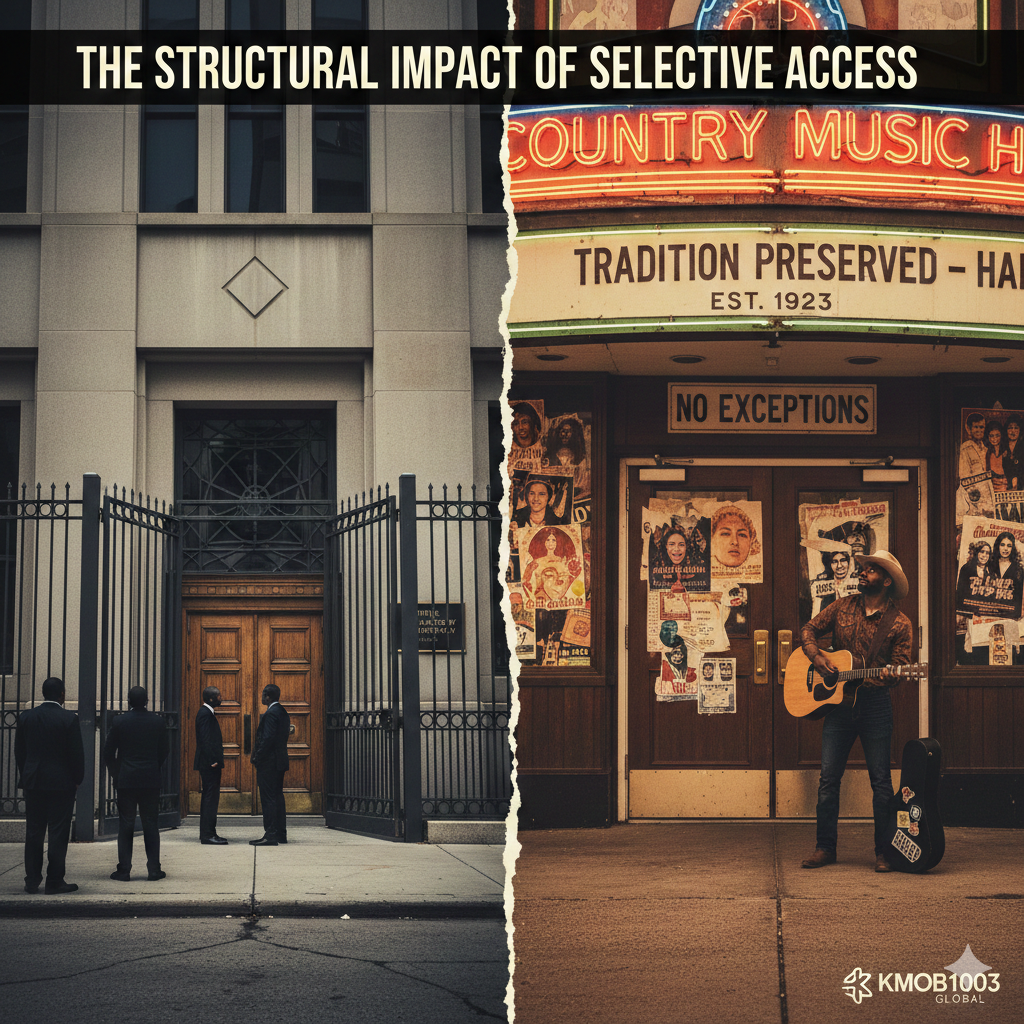
Access is not symbolic. It is structural. When bias determines the invitation list, the institution is already compromised.
When decision circles narrow without merit-based cause, the damage extends beyond those excluded. It destabilizes legitimacy itself.
Across governance, country music, and corporate leadership, one principle remains constant: if power is weaponized through exclusion, the architecture of the room is already defective.
“Power is rarely taken in a single act. It is normalized through small permissions — who gets the calendar invite, who gets the room, who gets the microphone.”
The Mechanics of Exclusion
“Selective access” is often framed as logistics. In reality, it is a governance tool. When leaders decide who is allowed into a room based on comfort, loyalty, or identity, they are not managing time — they are managing legitimacy.
The consequence is predictable: an echo chamber forms, blind spots expand, and the institution begins confusing agreement with strength. Exclusion is not just disrespect; it is a strategic vulnerability.
The Governance Signal
In high-level public leadership, the invitation list is a proxy for authority. When certain executives are left out without objective cause, the system forces everyone else to choose: complicity or institutional integrity.
The most consequential response is rarely a statement. It is a refusal to participate in a fractured meeting. When peers withdraw together, they strip “access” of its weaponized value and reassert the legitimacy of the collective.
KMOB1003 Partner | Protection Architecture
 Operationalizing the Perimeter
When access becomes politicized, risk becomes personal. Design the perimeter intentionally—reputational, operational, or personal protection should be designed, not improvised.
The Boardroom Translation
The same playbook exists inside corporate leadership: project steering groups, executive offsites, investor dinners, “strategy” meetings that quietly become loyalty tests. The institution is not harmed only when bias is expressed — it is harmed when bias is rewarded with silence.
The correction is structural: if one qualified leader is excluded without merit-based rationale, the room is defective. A credible organization does not treat access as a favor. It treats access as a governance standard.
If you’re building your platform instead of renting attention, Bluehost remains a clean foundation for durable ownership.
Country Music and the Gatekeeping Test
Culture has its own boardrooms. Genres do not just “exist”; they are curated by radio, awards, and legacy networks that decide what counts as authentic. The conversation surrounding Beyoncé’s entry into country music served as a structural stress test.
The real question was never about talent. It was about whether the institution would treat a global artist as a participant or an exception. Inclusivity is only proven when the gate opens without the guest needing to perform gratitude.
Every genre has an invitation list. The only credible version of tradition is one that survives contact with talent.
What To Do When This Is Happening
For the excluded leader:
Refuse the vacuum. Exclusion is designed to make you invisible. Move your work to a parallel stage with equal visibility — publish, convene, brief, document. Build a peer perimeter; your authority is confirmed by the peers who treat you as necessary.
For peers who witness bias:
Enforce the all-or-none standard. If one qualified leader is excluded without objective rationale, the legitimacy of the gathering collapses. Do not validate a compromised room. Make solidarity operational—walking out, rescheduling, refusing to proceed until the table is whole.
KMOB1003 Final Word
Institutions reveal themselves at the invitation list. When inclusion is tested, the highest form of leadership is not outrage — it is structure. A credible organization does not treat access as a favor; it treats access as a governance standard.
KMOB1003 Curated | Power & Perspective

The 48 Laws of Power (Audible)
A disciplined framework for leverage, perception, and power dynamics inside closed systems.

Major Labels: A History of Popular Music
A clean study of genre legitimacy, cultural gatekeeping, and who decides what “belongs.”

Team of Rivals: Political Genius
A masterclass in leadership built through tension, inclusion, and disciplined coalition.
