
The Intelligence Series | The Searchable Archive
It didn’t happen during a keynote or a board vote. Instead, it happened quietly—after the meeting ended. The briefing was sharp, multilingual, and high-stakes. Decisions were made in real time. Consequently, everyone left confident they’d “remember the important parts.”
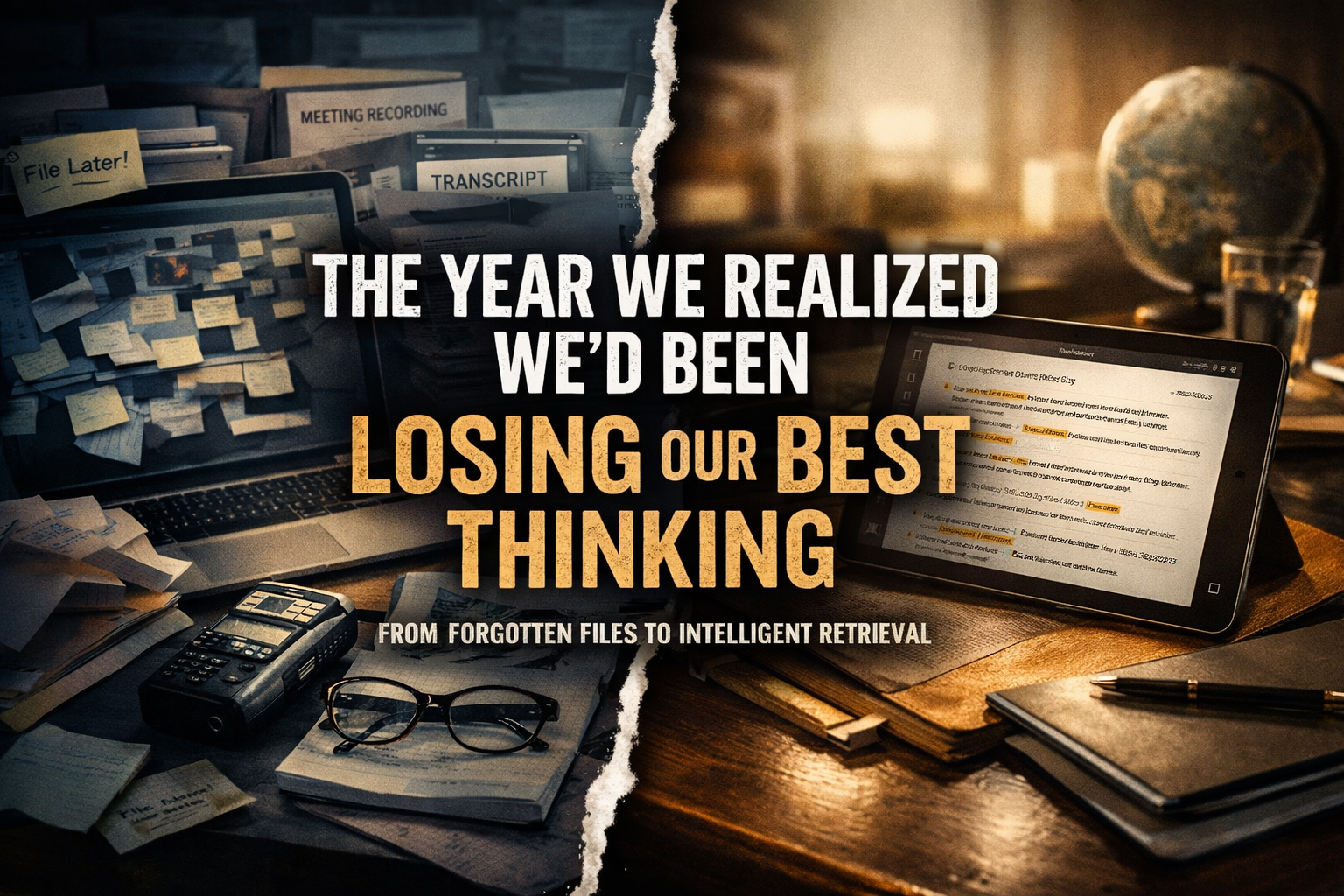
Two weeks later, no one could find them. The recording existed somewhere, buried in a folder, untagged, and unsearchable. In short, it was functionally dead. That was the moment many leaders had the same realization: We didn’t lose our best ideas — we just forgot where we left them.
How Digital Memory Broke Without Us Noticing
For years, we treated recordings like insurance policies—nice to have, but rarely opened. However, the world changed faster than our habits. Meetings became global and conversations became multilingual. Indeed, the KMOB1003 Society was producing denser intelligence, yet human memory couldn’t keep up.
Specifically, context was vanishing. As a result, we weren’t building knowledge; we were leaking it. By the time we noticed, the damage was already done. We were everywhere, yet we preserved almost nothing.
The Shift: From Recording to Retrieval
The pivot didn’t start with technology. Rather, it started with ego. Leaders finally admitted that recall is not the same as intelligence. Furthermore, the people pulling ahead weren’t the ones who spoke the most. They were the ones who could return to what was said with absolute precision.

The Tool That Changed the Behavior
This is where Scribe v2 entered the workflow as a new standard. Specifically, briefings weren’t just recorded; they were converted into assets. By utilizing word-level transcripts, leaders stopped relying on vague summaries and started operating from exact recall.
Thoughts that once disappeared now lived where they could compound. Therefore, digital agency relies on the transcription precision of ElevenLabs and the encryption provided by NordVPN.
